
Your 3PL Has an Automated Storage and Retrieval System. What Changes for Your Orders?
Key Takeaways
- An AS/RS stores items in assigned locations and brings them back on demand, so the item comes to the picker instead of the picker walking to the item.
- The main gains are more storage in the same space, less walking, fewer pick errors, and accurate location data.
- It has real limits: upfront cost, installation time, product fit, data dependence, and downtime.
- It is one stage of fulfillment. Receiving, packing, and carrier handoff still decide whether orders ship on time.
- Ask any 3PL what its AS/RS covers, whether your product mix fits, how it stays in sync with the warehouse system, and what the fallback is.
- ShipSage has an AS/RS at its Chicago fulfillment center for small parcels.
A brand signs with a 3PL partly because the spec sheet lists an automated storage and retrieval system. A few weeks in, orders ship no faster than before. Nobody lied. The automation sped up one step, and the delay was somewhere else. It is a common version of this story, and it is avoidable.
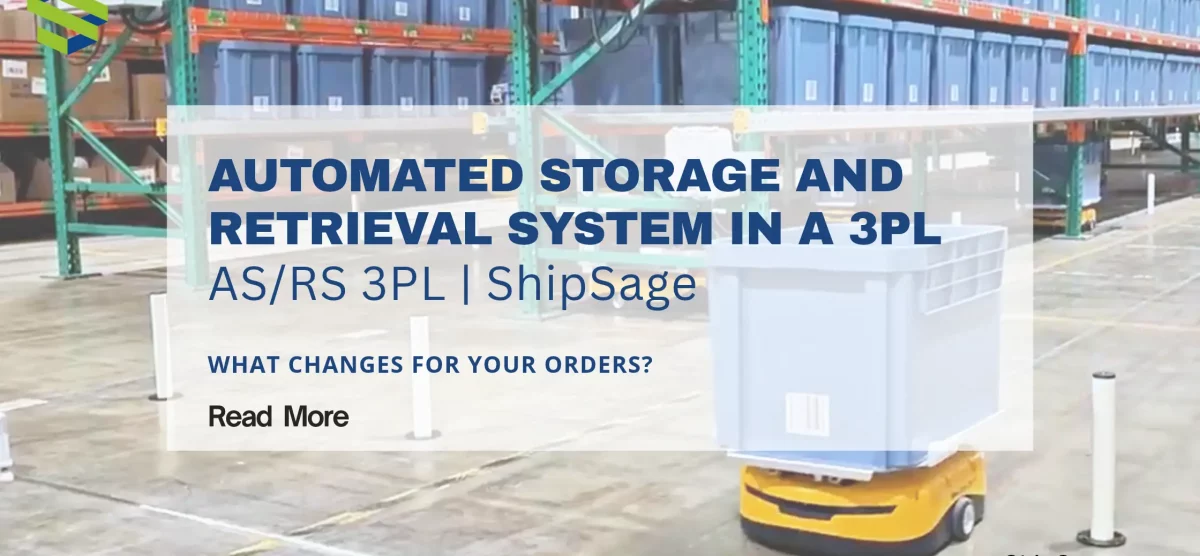
An automated storage and retrieval system (AS/RS, also written ASRS) is automated equipment, run by software, that puts items into assigned storage locations and brings them back out when an order needs them. If you ship through a 3PL, the useful question is not whether the warehouse has one. It is what the system changes for your orders. In practice, that depends on what is stored in it, how it connects to the rest of the warehouse, and what happens when it is not available.
How does an automated storage and retrieval system actually work?
The details vary by vendor and design, but the cycle is the same:
- Inventory is received and scanned.
- The item goes into a container, and the machine carries it to an open storage location.
- Software records exactly where it is.
- When an order needs the item, software tells the system to retrieve the container.
- The container arrives at a station, where a person or a machine picks the item. The container then goes back into storage.
Notice what moved. The item came to the picker. In a traditional warehouse, the picker walks to the item. That is why you will hear this called goods-to-person picking.
Systems range from pallet cranes to small-bin shuttles. For ecommerce, bin and shuttle systems matter most, because most online orders are small items stored in small containers. Vertical lift modules and grid-based systems are other types you will see.
What does an AS/RS change for your orders?
- Storage density. Equipment can work in narrow aisles and tall racks that people could not use safely, so the same building holds more inventory.
- Less walking. Items come to the picker, so less picker time goes to travel.
- Fewer pick errors. Software directs which container arrives and where the item sits, so there are fewer chances to pick from the wrong location.
- Accurate location data. Every item has a recorded location, which supports better counts.
That sounds simple. It isn’t. The size of each gain depends on the system, the product mix, and how disciplined the warehouse is around it. Be wary of any single percentage quoted without that context.
Where does an AS/RS fall short?
- Cost. There is no single price. It depends on size, type, and how much software integration it needs.
- Installation time. Systems take weeks to months to design, install, and test before they hold live inventory.
- Product fit. Small, uniform, stable items suit it best. Bulky or irregular items are harder.
- Data dependence. The system is only as good as the software and inventory data behind it.
- Downtime. If a machine goes down, the operation needs a way to keep picking.
Here’s where most brands get it wrong: they treat the AS/RS as the whole fulfillment operation. It is one stage. Receiving, packing, labeling, and carrier handoff still decide whether an order ships on time. For a wider look at where automation helps and where people still do better, see automation vs. manual labor in warehousing.
What should you ask a 3PL about its AS/RS?
Ask your 3PL about this before you sign anything:
| Question | Why it matters |
|---|---|
| What does the AS/RS cover, and what is still manual? | Automation is rarely all or nothing. Know which steps it handles. |
| Can my product mix actually use it? | Small, uniform items fit bin systems. Bulky or oddly shaped items may not. |
| How do the warehouse system and the AS/RS stay in sync? | Stock counts are only as good as that connection. |
| What happens if it goes down? | A reliable partner has a fallback so orders keep moving. |
| Can I see inventory in real time in my own account? | Automation only helps if you can see current stock. |
Two of those are covered in more depth elsewhere: real-time inventory tracking and how orders flow in from your sales channels on our integrations page.
What does ShipSage’s AS/RS cover?
ShipSage already has an AS/RS at its Chicago fulfillment center, built for small parcels. Here is what the Chicago tour shows:
- Bin storage on high-density shelving for small-parcel inventory, including clothing and other small items.
- The AS/RS area: 12 layers of small bins, double-deep, aimed at increasing small-parcel storage density.
- Inline DWS carrier sorting: parcels are dimensioned, weighed, and scanned on a conveyor, then sorted to the right carrier.
That is the layout, not a performance claim. This post makes no results claims for it, so ask us how it fits your SKU mix. Behind it sits the ShipSage WMS, which includes live tracking of inventory and orders, and all your channels share one inventory pool. See the walk-through in our Chicago warehouse automation tour, how it fits our order fulfillment services, or read How Robotics and Automation are Transforming Warehousing and Fulfillment.
Frequently asked questions
What does AS/RS stand for?
AS/RS stands for automated storage and retrieval system. It is also written ASRS. Both refer to automated equipment and software that store items and retrieve them on demand.
What is an automated storage and retrieval system used for?
It is used to store inventory densely and bring it back out with less manual work. Warehouses, distribution centers, manufacturers, and fulfillment centers use them. In ecommerce, bin and shuttle types handle small items stored in small containers.
How much does an automated storage and retrieval system cost?
It varies widely with size, type, and software integration, so there is no single figure. Small bin systems and large pallet systems sit at very different price points. A vendor has to scope the operation before quoting.
What are the advantages of an automated storage and retrieval system?
The main advantages are more storage in the same space, less walking for pickers, fewer pick errors, and accurate location data. How large each gain is depends on the system, the product mix, and the warehouse around it. Ask for specifics on your own SKUs.
Does ShipSage use an AS/RS?
Yes. ShipSage already has an AS/RS at its Chicago fulfillment center, built for small parcels. The area is 12 layers of small bins, double-deep. The Chicago tour shows the layout.
The bottom line:
An AS/RS is a tool, not a promise. It can store more and pick cleaner, but only when the data, the product mix, and the rest of the warehouse keep up. Judge a 3PL by what its automation changes for your orders, not by its equipment list.
Ready to Upgrade Your Fulfillment?
At ShipSage, we work with growing ecommerce brands to provide flexible, scalable 3PL fulfillment — no long-term contracts, real people, and a nationwide warehouse network built for speed. Whether you’re shipping 500 orders a month or 50,000, we’re ready to help you deliver like a giant.
Fill out the form below to start a conversation with our team. →