
What Is DTF Printing? How PrintSage Processes DTF Print-on-Demand Orders
DTF printing — Direct-to-Film — is one of the two production methods PrintSage uses to fulfill custom print-on-demand orders. If you’ve heard the term and want to understand what it actually means, how it works, and why it matters for sellers building a print-on-demand brand, this post covers all of it.
DTF is distinct from DTG (Direct-to-Garment), the other major digital printing method. Where DTG prints ink directly into the fabric fibers, DTF takes a different route: the design is printed onto a specialized transfer film first, then heat-pressed permanently onto the garment. The result is a vivid, durable print that works across a much wider range of fabric types — including polyester, nylon, and synthetic blends that DTG can’t handle effectively.
What Is DTF Printing?
Direct-to-Film (DTF) printing is a digital garment decoration method that uses a specialized inkjet printer to produce a full-color design — including white ink — on a polyester transfer film. The film is coated with a hot-melt powder adhesive after printing, then cured and heat-pressed onto the target garment. Once applied, the adhesive bonds the design permanently to the fabric surface, creating a wash-durable, vibrant print.
Unlike screen printing, DTF requires no screens, stencils, or minimum order quantities. Every design prints digitally, which means a one-off custom shirt costs the same per unit to produce as a bulk run. Unlike DTG, DTF doesn’t require fabric pretreatment and works on virtually any fabric type — cotton, polyester, nylon, spandex, blends — which is what makes it the more versatile method for a wider product catalog.
How DTF Printing Works: The Production Process at PrintSage
Here’s what happens from the moment an order enters the PrintSage system to the finished shirt going into a mailer.
Order Intake and Production Queue
Orders flow into PrintSage automatically from connected storefronts — Shopify, TikTok Shop, Etsy, Amazon, Temu, Walmart, and 100+ other platforms. Both e-commerce seller orders and direct consumer orders from PrintSage.com enter the same production queue each morning. The system handles order routing, design file processing, and SKU matching before production begins — by the time the first film comes off the printer, every order already knows which blank it’s going onto and which fulfillment station it’s heading to.
DTF Film Printing
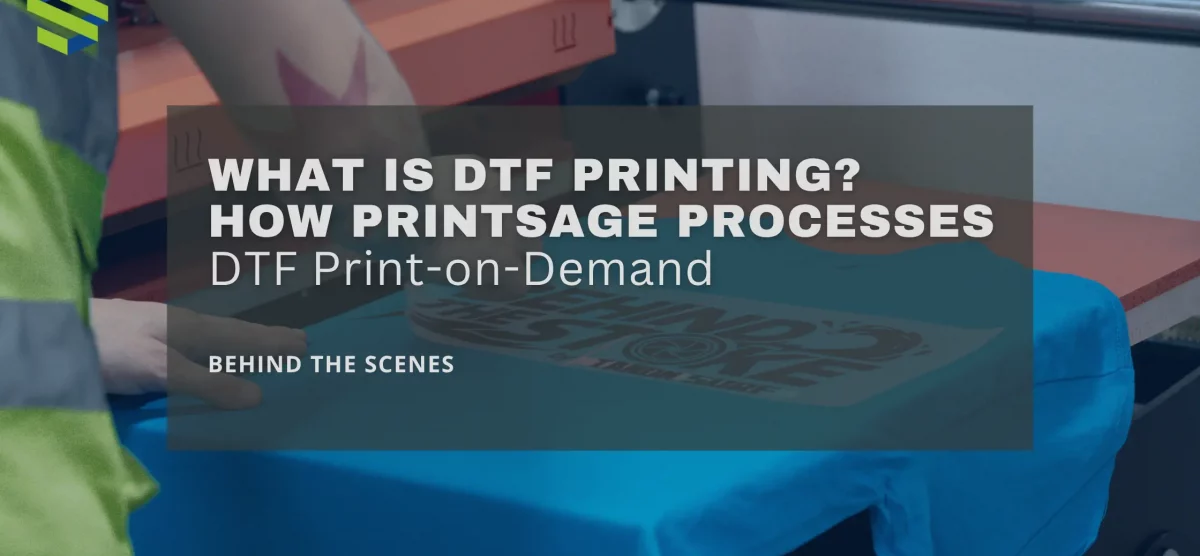
The production floor starts with the DTF printers. Commercial DTF machines print the design in full color — including a white ink layer — onto a polyester transfer film in a single pass. The white ink prints first in reverse, then the color layers are applied on top. This is what allows DTF to reproduce accurately on both light and dark garments without any pretreatment step.
After printing, a hot-melt powder adhesive is applied to the wet ink and cured in an oven. This activates the adhesive that will bond the design to the garment during pressing. At this point the film is a finished transfer, ready to be cut and matched to its garment.
Blanks Fulfillment and Picking
While the DTF machines are running, the warehouse team works in parallel on blanks fulfillment — pulling the correct garment color, style, and size for each order in the queue. Blank inventory is held across ShipSage’s 6 US fulfillment centers, positioned to minimize shipping distance to the end customer. Accurate picking at this stage is what keeps a custom order custom — the wrong blank here means the wrong shirt at the customer’s door, regardless of how good the print turns out.
Film Cutting and SKU Matching
Once the printed and cured films come off the line, they’re cut to size and matched to their corresponding blank. Each film is trimmed to the correct dimensions for its garment, and the design and garment are confirmed against each other — right design, right size, right colorway — before anything moves to the heat press. This SKU-matching step is the quality gate between production and application.
Heat Press Application
The heat press is where the DTF transfer bonds permanently to the garment. The blank is positioned on the press platen, the film is placed face-down, and the press applies a precise combination of heat, pressure, and time — typically 275–325°F for 10–15 seconds depending on fabric type and transfer specification. Getting these variables right is critical: too little heat and the adhesive doesn’t fully activate; too much and the fabric or print quality is compromised. After pressing, the carrier film is peeled away, revealing the finished design bonded to the garment surface.
Quality Check, Packing, and Fulfillment
Every finished garment is inspected for print accuracy, color consistency, and adhesion quality before it moves to fulfillment. After quality check, orders are sorted by carrier and service level, packed into their mailers, and scanned into the system before dispatch. Tracking updates push automatically back to the originating storefront. From there, ShipSage’s fulfillment network handles carrier routing and last-mile delivery — typically reaching most US customers within 2 business days of dispatch.
DTF vs. DTG Printing: What’s the Difference?
Both DTF and DTG are digital printing methods used for custom garment production. The right choice depends primarily on the fabric:
DTF works on cotton, polyester, nylon, spandex, and virtually any fabric type. No pretreatment required. Prints sit slightly on top of the fabric with a defined surface texture. Best for dark garments, synthetic fabrics, and sellers who need fabric flexibility across their product catalog.
DTG prints ink directly into the fabric fibers, producing a softer hand feel. Works best on 100% cotton and high-cotton blends. Requires pretreatment for white ink on dark garments. Best for cotton-heavy product lines where a soft, fabric-integrated feel is a priority.
PrintSage uses both methods depending on the product. For a detailed walkthrough of the DTG process, see How Print-on-Demand T-Shirts Are Actually Made: The DTG Process Explained→.
Why DTF Printing Works for Print-on-Demand Sellers
DTF has become one of the dominant production methods in the print-on-demand industry for a few practical reasons:
No minimum order quantity. The digital production process means one shirt costs the same per unit as a hundred. That’s the economic foundation of the POD model.
Fabric flexibility. DTF works on fabric types that DTG can’t handle — polyester activewear, nylon accessories, blended fabrics — which expands the product range a seller can offer without switching production methods.
Dark garment capability. Because DTF always includes a white ink underbase, it reproduces accurately on dark garments without the pretreatment step DTG requires. Faster per-unit production on dark fabrics.
Wash durability. A properly applied and cured DTF transfer holds up through repeated washing. Wash-care recommendations — cold water, inside-out, avoid high-heat drying — extend the life of the print further.
Scalability. The parallel production structure — DTF machines printing films while the warehouse team pulls blanks simultaneously — is what allows the operation to absorb order volume spikes without a production backlog.
For Shopify sellers specifically, DTF print-on-demand through PrintSage means your store runs on automatic: a customer purchases, the order routes directly into production, and tracking pushes back to your Shopify storefront without any manual steps. The PrintSage Shopify app connects your store to the same DTF production floor shown in the video above — no middleware, no third-party routing, no separate dashboard to manage. For small business Shopify sellers who want the economics of in-house DTF production without buying the equipment, this is the model: PrintSage handles the production, ShipSage handles the fulfillment, and you focus on growing the store.
For sellers running on platforms with strict delivery speed requirements — Amazon SFP, TikTok Shop — production throughput directly affects your ability to meet fulfillment SLAs. See our Seller Fulfilled Prime requirements post for context on how production speed connects to marketplace badge eligibility.
Frequently Asked Questions About DTF Printing
What does DTF stand for?
DTF stands for Direct-to-Film. It refers to the production method where a design is printed onto a polyester transfer film before being heat-pressed onto the garment, as opposed to printing directly onto the fabric itself.
Is DTF printing good quality?
Yes. A properly applied and cured DTF transfer produces vibrant, full-color prints with excellent wash durability. Color accuracy is high across both light and dark garments, and the print holds its definition through repeated washing when care instructions are followed.
What fabrics can DTF print on?
DTF works on virtually any fabric type — cotton, polyester, nylon, spandex, canvas, and synthetic blends. This fabric flexibility is one of DTF’s primary advantages over DTG, which performs best only on cotton and high-cotton blends.
How long does DTF production take?
At PrintSage, production completes within 2 business days of order receipt. Combined with 2-business-day US shipping from a ShipSage fulfillment center, most customers receive their order within 4–5 business days of placing it.
Is there a minimum order for DTF print-on-demand?
No. PrintSage fulfills single-unit orders and large batches through the same production line. There’s no screen or stencil setup to amortize, so one piece carries the same per-unit cost as a hundred.
Can DTF print on dark garments?
Yes. Because DTF always includes a white ink layer printed first, it reproduces full-color designs accurately on dark garments without any additional pretreatment step. This is one of DTF’s practical advantages over DTG on darker fabrics.
What’s the difference between DTF and screen printing?
Screen printing uses physical stencils — one per color — and requires a minimum order quantity to be cost-effective, since setup costs are spread across the run. DTF prints digitally with no stencils, no per-color setup, and no minimums. DTF also handles unlimited colors in a single pass, where screen printing costs increase with each additional color.
The Bottom Line
DTF printing is a versatile, high-quality production method that removes the two main barriers of traditional garment decoration — minimum orders and setup costs per design — while extending the range of printable fabrics beyond what DTG alone can handle. Combined with ShipSage’s 3PL infrastructure, PrintSage gives sellers access to in-house DTF production backed by a professional US fulfillment network. Whether you’re selling on Shopify, TikTok Shop, Etsy, or Amazon, or ordering a single custom piece for yourself, the production process behind every order is the same.
The Wise Way to Print.
In-house DTF and DTG production. 6 US warehouses. No minimums, no monthly fees. Start selling or order for yourself today.
Visit PrintSage.com | Get a 3PL + POD Quote
Ready to Upgrade Your Fulfillment?
At ShipSage, we work with growing ecommerce brands to provide flexible, scalable 3PL fulfillment — no long-term contracts, real people, and a nationwide warehouse network built for speed. Whether you’re shipping 500 orders a month or 50,000, we’re ready to help you deliver like a giant.
Fill out the form below to start a conversation with our team. →