
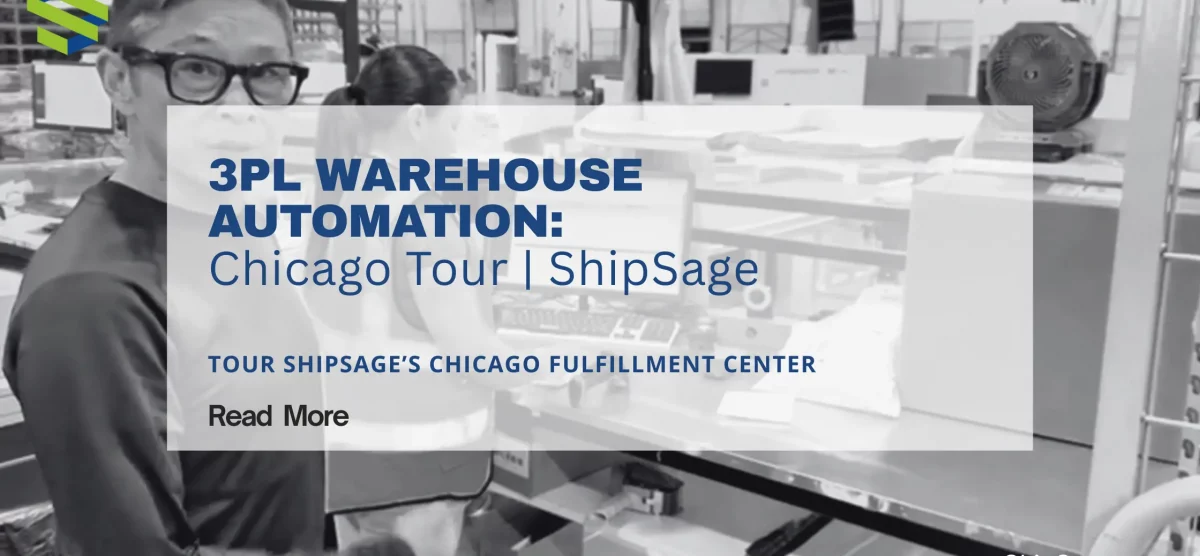
How Amazon & Shopify Orders Get Fulfilled: A Tour of ShipSage’s Chicago Warehouse
3PL warehouse automation is easy to describe and hard to picture. A brand sends an order, a few days later a box arrives, and almost everything in between is invisible. Knowing what actually happens on the floor helps you judge how a fulfillment partner will handle your orders, especially when they include both single items and multi-item baskets.
In this tour, ShipSage Founder Ben Pu walks through our Chicago MDW fulfillment center to show how Amazon and Shopify orders get picked, packed, scanned, and sorted to the right carrier, and where a new automated storage and retrieval system (AS/RS) will fit in. This post walks through each area in the order work flows.
Part 1: Storage and Picking
Small Parcel Bin Storage
Small-parcel inventory in Chicago is stored in bins on high-density shelving. In the tour you can see clothing and a mix of other small merchandise kept this way. Bins hold many small products in a compact footprint, and each product can be found and picked on its own.
Hand Carts and Order Picker Carts
Picking into totes uses two kinds of carts:
- Hand carts — pushed by an associate for ground-level picking
- Machine carts — use an order picker to lift the associate up to high shelving so they can pick into a tote at height
Empty tote carts are stored in their own area, ready to go back out to the floor. For the basics of how picking and packing work, see our pick and pack explainer.
Part 2: Packing Stations
Picked totes are dropped off at the packing area, where the order’s shape decides which workflow it follows. The Chicago floor runs two.
Single-Item Orders
- Inventory for single-item orders is picked and brought to a dedicated single-item station
- The packer scans the SKU barcode, and the shipping label comes up
- The label goes on the parcel, and the packed order moves to the conveyor
Multi-Line Orders
- Totes are dropped off at a staging area, where each bin makes up one order
- The associate scans the tote, and the shipping label comes up
- Items are then verified by scanning one SKU at a time, which confirms that what was picked matches the order
- Once verified and packed, the parcel goes onto the conveyor
Single-item orders are the simpler workflow because nothing needs to be combined. Multi-line orders get the extra check because several products come together in one box.
Part 3: Inline DWS and Automated Carrier Sorting
What Is a DWS System?
DWS stands for dimensioning, weighing, and scanning. A DWS machine measures a parcel’s dimensions, weighs it, and reads its barcode as it travels along a conveyor, all in one pass.
How It Works at the End of the Line
After packing, associates place each parcel on the conveyor and it passes through the DWS machine. The machine takes a photo, measures the dimensions, scans the barcode, and then sorts the parcel automatically to the right carrier. In the tour, the carriers include USPS, GOFO, and UniUni, with other regional carriers handled the same way.
This matters because carriers price parcels by size as well as weight. Capturing both on every parcel at the line keeps that data consistent. To see how size affects what you pay, read our guide to DIM weight in shipping.
Part 4: What’s Coming — The AS/RS Installation
An AS/RS, or automated storage and retrieval system, uses automated equipment to put items into storage locations and bring them back out, instead of having an associate walk or lift to a shelf.
In the video, Ben shows the area reserved for ShipSage’s AS/RS project: 12 layers of small bins, double-deep. At the time of filming, the team expected installation to begin in about six weeks. It is aimed at expanding small-parcel storage density at the site. For more on how we think about automation, see automation vs. manual labor in warehousing.
Why This Matters for Amazon and Shopify Sellers
The floor is only half of it. Orders reach the warehouse through your sales channels, and ShipSage connects to Shopify and Amazon through its integrations so orders flow in without manual entry. See our Shopify fulfillment and Seller Fulfilled Prime pages for how those connections work, or watch our other walkthrough, Inside a Seller Fulfilled Prime Warehouse.
For your brand, the tour comes down to three practical things: every order is checked against what was picked before it is sealed, parcels are measured and weighed on the line, and carrier sorting is automatic. To see where our fulfillment centers are, visit our locations page.
Frequently Asked Questions
What is 3PL warehouse automation?
It is the use of automated equipment and software, such as conveyors, DWS machines, scanners, and storage systems like AS/RS, alongside people to move, check, and ship customer orders. In ShipSage’s Chicago site, that includes inline DWS carrier sorting today and an AS/RS on the way.
What does DWS stand for in a warehouse?
Dimensioning, weighing, and scanning. The machine measures a parcel’s size, weighs it, and scans its barcode in one pass.
What is an AS/RS?
An automated storage and retrieval system. It stores and retrieves items automatically from storage locations. ShipSage’s planned Chicago system uses 12 layers of small bins, double-deep.
What is the difference between single-item and multi-line packing?
Single-item orders contain one SKU and are packed at a single-item station. Multi-line orders contain several items, arrive in totes, and are verified by scanning each SKU one at a time before packing.
Which carriers does the Chicago DWS line sort to?
The tour shows automatic sorting to USPS, GOFO, UniUni, and other regional carriers, based on the carrier on each parcel’s label.
The Bottom Line
Warehouse automation works best when it supports a clear process rather than replacing one. In Chicago, associates pick, verify, and pack, and machines measure, weigh, scan, and sort. The AS/RS will add more storage for small parcels. If you want to see how a partner works before you commit, the video above is the quickest way, and our team can walk you through the rest.
Ready to Upgrade Your Fulfillment?
At ShipSage, we work with growing ecommerce brands to provide flexible, scalable 3PL fulfillment — no long-term contracts, real people, and a nationwide warehouse network built for speed. Whether you’re shipping 500 orders a month or 50,000, we’re ready to help you deliver like a giant.